
Early Stages of High-mass Star Formation
Early Stages of High-mass Star Formation

Magnetic Fields in High-mass Star Formation

Binary Formation, Accretion Disks, Infall Streamers

Origin of Stellar Masses, Core Mass Function

Initial Physical/ Chemical Conditions of High-mass Star Formation

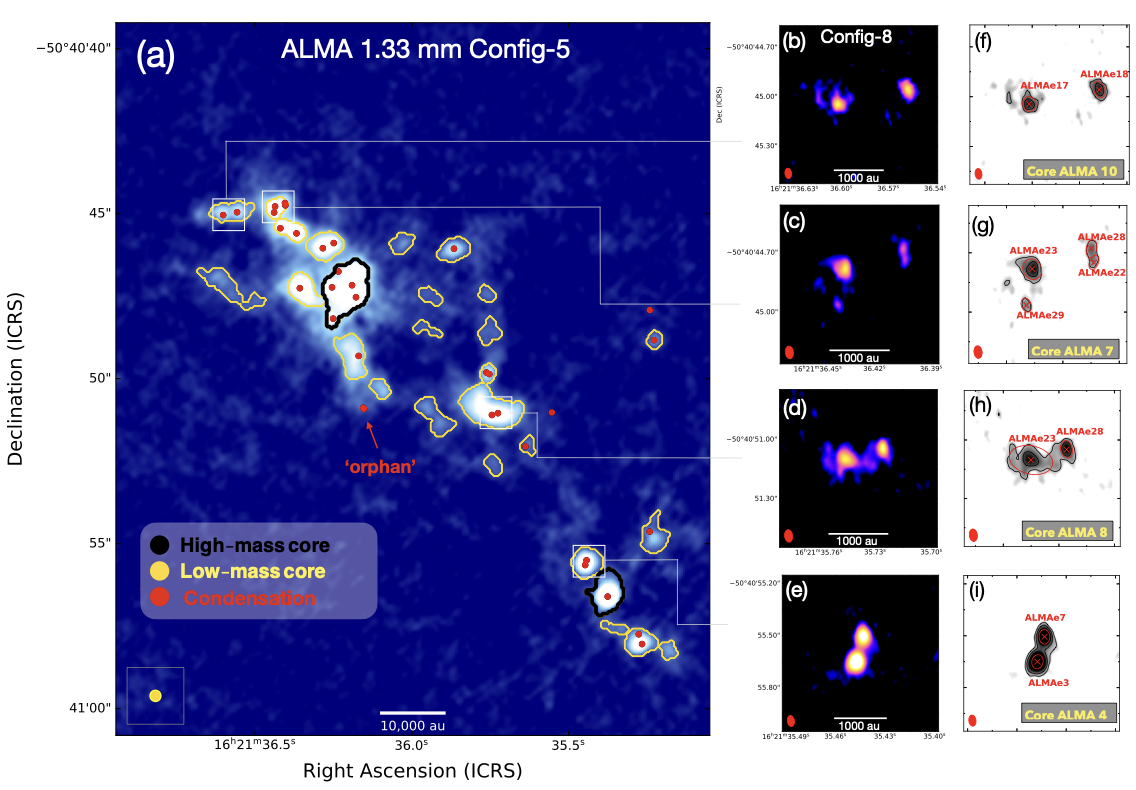
The DIHCA survey aims to address many key questions that require the high angular resolution that only ALMA can provide. The main goals are to determine how common accretion disks around high-mass stars are, how high-mass stars are fed, and what process dominates the formation of binary systems in high-mass star-forming regions. We use ALMA to observe dust continuum and molecular line emission from 30 high-mass star-forming regions in a range of evolutionary stages (same target list as MagMaR). Single-pointing observations in 2 ALMA configurations at ~220 GHz (1.33 mm) were used, providing an angular resolution of ~0.3" and 0.05" (∼1000 and ~150 au, respectively, at the average source distance).
 |
DIHCA I. Dissecting the High-mass Star-forming Core G335.579-0.292 MM1 Olguin, Sanhueza et al. (2021) |
|
DIHCA II. Exploring the Inner Binary (Multiple) System Embedded in G335 MM1 ALMA1 Olguin, Sanhueza et al. (2022) |
 |
 |
DIHCA III. The Chemical Link between NH2CHO, HNCO, and H2CO Taniguchi, Sanhueza et al. (2023) |
|
Observations of high-order multiplicity in a high-mass stellar protocluster Li, Sanhueza et al. (2023) |
 |
 |
Digging into the Interior of Hot Cores with ALMA: Spiral Accretion into the High-mass Protostellar Core G336.01-0.82 Olguin, Sanhueza et al. (2023) |
|
DIHCA IV. Fragmentation in High-mass Star-forming Clumps Ishihara, Sanhueza et al. (2024) |
 |
 |
DIHCA V. Deuterium Fractionation of Methanol Sakai et al. (2025) |
|
DIHCA VI. The Formation of Low-mass Multiple Systems in High-mass Cluster-forming Regions Luo, Sanhueza et al. (2026) |
 |
 |
DIHCA VII. Disk Candidates around High-mass Stars and Evidence of Anisotropic Infall Olguin, Sanhueza et al. (2026) |